I work on agentic commerce, so I drink a lot of the kool-aid. Every week there’s a new protocol, a new checkout button inside a chatbot, a new demo of an agent buying socks.
A few weeks ago I put my product manager hat back on and asked the question I’d ask about any feature: who actually wants this? Not who is building it. Who is asking for it.
I went looking for the customer. There are two of them, shoppers and retailers, and the data says both are pulling back. So I tried to answer a narrower question: which one wants it less?
Shoppers want help, not a buyer
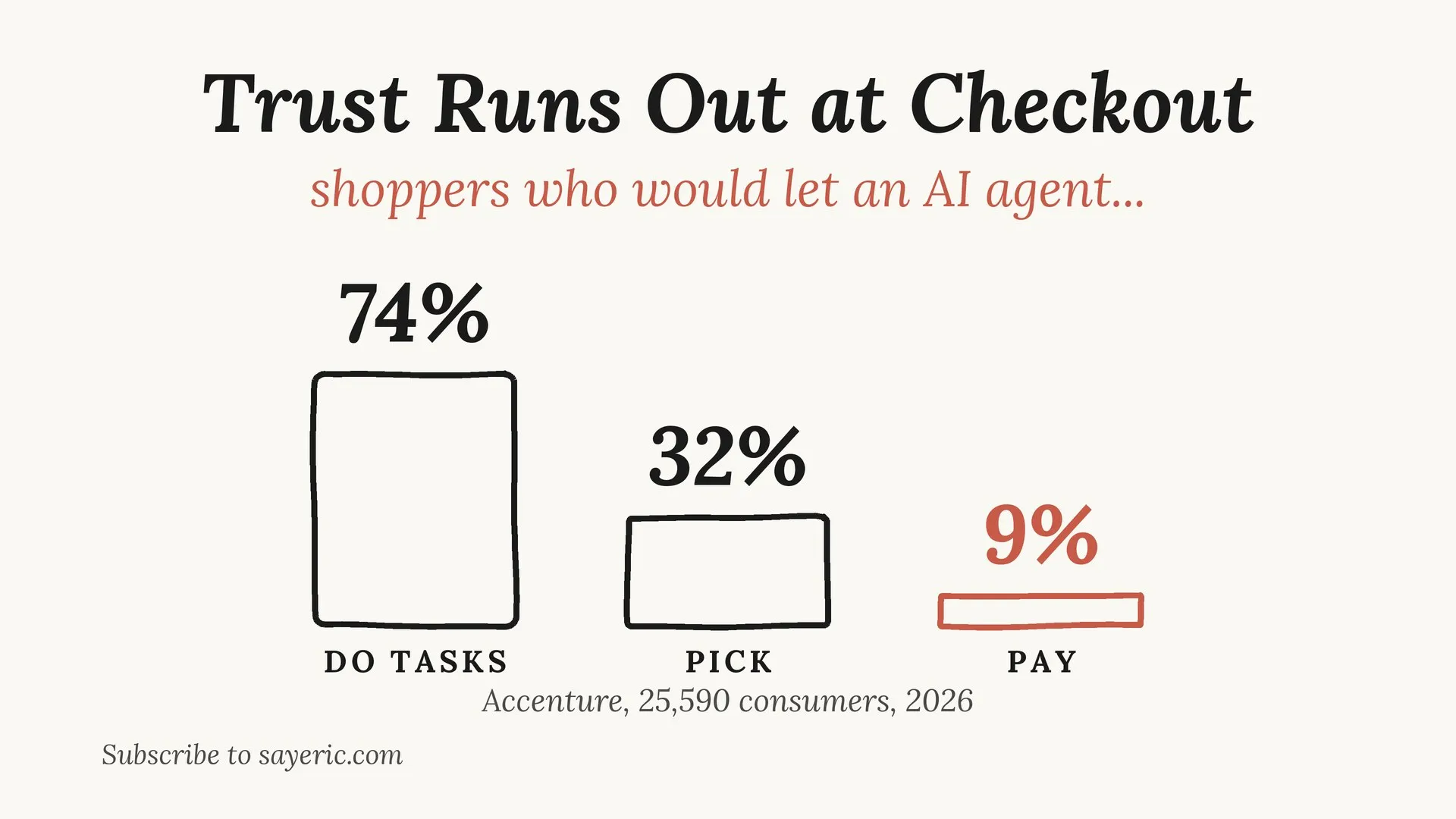
1. Trust runs out right before payment. Accenture surveyed 25,590 consumers in 16 countries for its 2026 Consumer Pulse report. 74% would let an agent handle routine tasks like reorders and complaints. 32% would let it decide what to buy. Only 9% would let it buy on its own. Each step closer to the card, about two-thirds of the people drop out.
Look at the drop between pick and pay in the chart at the top. Shoppers are happy to let an agent choose. They just don’t want it holding the card.
This is a survey of what people say they’d do, so treat it as a ceiling. Real behavior is usually lower.
2. Shoppers use AI to research, then go buy somewhere else. Similarweb’s US panel found AI leads search at every stage from discovery through evaluation, often by 2 to 1. At the last step, finding where to buy and the best price, the gap almost closes: 24.3% for AI versus 22.1% for search. a16z made the same point in its Agents Denied charts: people bring AI in for homework on things they already found.
I’ve argued before that shoppers will lean in more with agents, and I still think that’s true for discovery. Checkout is a different story.
3. One mistake and they’re gone. ACI Worldwide and YouGov found 60% of UK shoppers would stop using a shopping agent after a single error. And errors are common. In the ShopSimulator benchmark, close to 80% of failed “buy now” steps came from the agent purchasing without confirming details, or after the user had already said no. That’s the reason I wrote about the harness around shopping agents. Today the harness is the shopper.
Retailers want the traffic, not the agent
1. The ad business runs on human eyeballs. Amazon made about $78 billion in ad revenue over the last four quarters. Its robots.txt refuses GPTBot, ClaudeBot, PerplexityBot and Google’s shopping agents. When Meta’s Muse arrived without a user agent to block, Amazon showed shoppers a page saying unauthorized AI agents violate its terms.
I’d love to point at Amazon’s Q3 ad growth, which dropped to 12% from 26%. But Amazon says most of that came from Prime Day moving into Q2. I don’t have data that agents caused any of it, so I’m not claiming it.
2. The agent does the work and search gets the credit. Similarweb tracked people who got a brand recommended in ChatGPT. When they later visited, 56% came through search and only 9% came straight from the AI. A retailer can’t budget for a channel its dashboard can’t see.
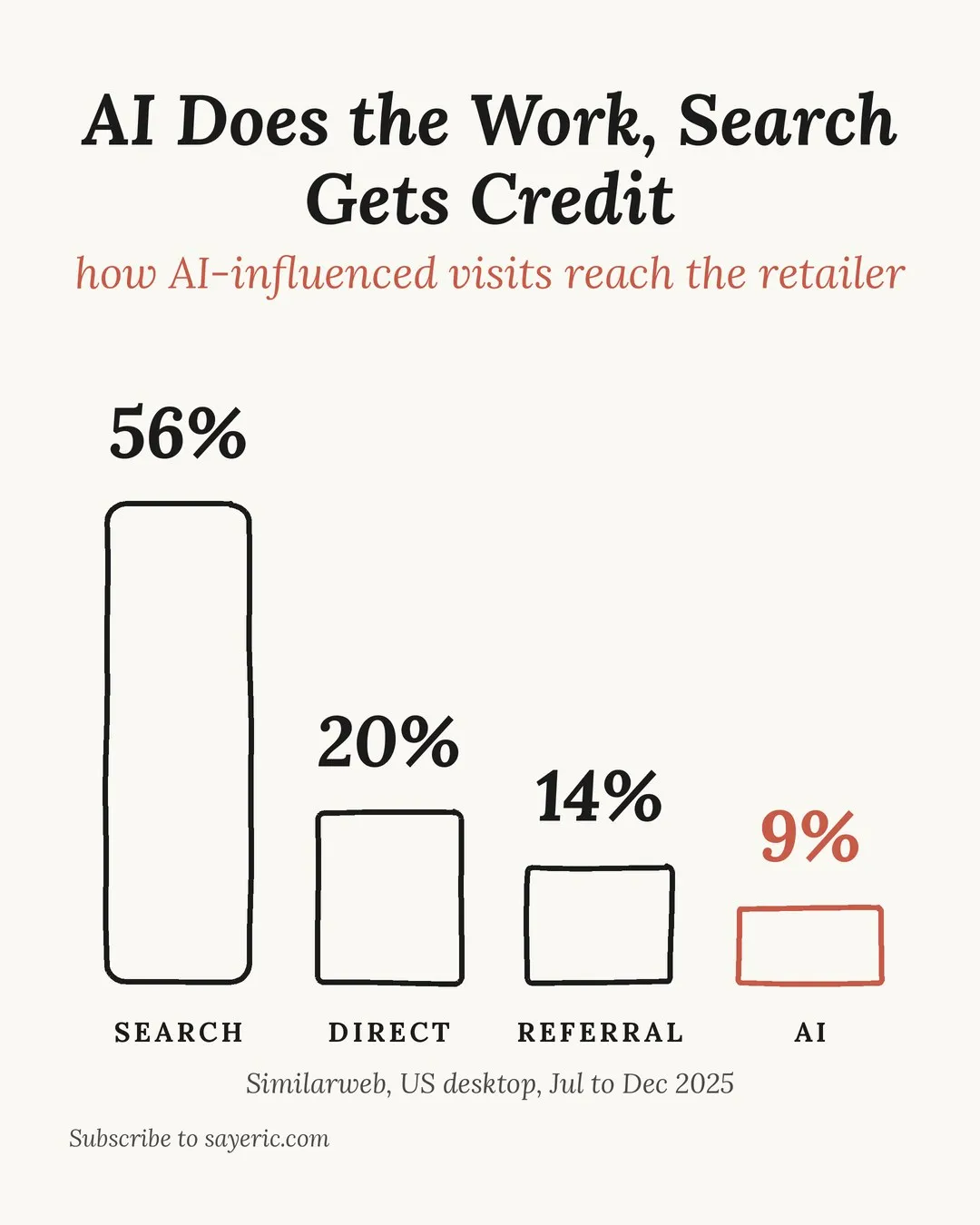
The coral bar is the only part a retailer’s dashboard credits to AI. Everything to the left of it looks like normal search and direct traffic.
3. Returns are already expensive before agents add to them. Shoppers returned $890 billion of merchandise in 2024, close to triple 2019, and NRF says 9% of returns are fraudulent. The Merchant Risk Council found 64% of merchants seeing more first-party misuse. Now add the new excuse: “I asked my agent for four AA batteries, not a 48-pack, please send a return label.” I understand why a retailer is in no rush.
Their own agent doesn’t change the answer
But doesn’t Amazon want an agent? It built one.
The strongest objection is that retailers don’t want agentic commerce less. They want it on their own terms. Amazon blocks outside agents and ships Alexa for Shopping.
I think that supports the argument. A retailer’s own agent only makes sense if the ad revenue survives it, which means the agent still has to put sponsored products in front of a human. That’s a better search box. It doesn’t solve trust at checkout or attribution for anyone else. It’s also why only 4 of 21 design partners on Meta’s Personal Agent Protocol are retailers.
Right now, neither wants it enough
My honest answer: right now, neither wants it enough to make it work. Consumers want help in the middle of the journey and control at the end. Retailers want the traffic and the checkout. Both are fine with an agent in the middle, and nobody has figured out who pays for the middle.
If you’re building here, I’d spend less time on the checkout button and more on the land grab upstream, in Hard-to-Keyword demand, where both sides already say yes.
Opinion of my own. Does not reflect eBay’s position.
What would it take for you to let an agent finish a purchase without looking at it first?