Everyday shoppers are going to need a harness for their AI agents, and I don’t think most people know that yet.
In AI engineering, “harness” is the word for the rules and tooling around a model. Birgitta Böckeler at Thoughtworks describes a harness as the tooling and practices that keep AI agents in check, and OpenAI built one to ship a product where agents wrote all the code. Thoughtworks also did a podcast episode on harness engineering if you want the engineering version. In practice it means deciding what an agent can touch, what it can do on its own, and when it has to stop and ask.
Engineers build harnesses because an agent with no rules does things nobody asked for. Until recently that was a developer problem. Now agents can buy things for regular people, and I think regular people will need the same kind of rules for the agents that shop for them. Most haven’t thought about it yet, because until now no software could spend their money without them pressing the button.
Shoppers want boundaries, but they won’t write them down
Agents can complete purchases today. With Meta’s Muse, you approve the total for each purchase in the chat before it goes through. I’ve written about how Muse’s checkout compares with Google’s and OpenAI’s. Per-purchase approval is a reasonable start, but it’s one rule applied to every purchase.
Real boundaries vary a lot more. Some are easy to state:
- Nothing over $100 without asking
- Never a seller with no return policy
Others are harder:
- Don’t rebuy something I just bought
- Ask me if it’s a gift for my wife
- Don’t buy anything I’d be embarrassed to return
The second list is the interesting one. I write a lot about Hard-to-Keyword demand, the shopping intent people never manage to type into a search box. Boundaries have the same problem. People know where their line is when an agent crosses it, but very few can describe it ahead of time.
Asking every time doesn’t work
The obvious objection is to skip the harness and have the agent confirm every purchase. I don’t think that holds up, for two reasons.
First, getting asked the same question over and over is annoying, and people stop reading prompts that annoy them. After enough approval cards, most people tap yes without looking, and at that point the confirmation isn’t protecting anyone.
Second, a rule you give an agent in chat doesn’t last. If you tell it “keep it under $50” while shopping for a birthday gift, that rule lives in that conversation. Start a new one next week and the agent may not know it, or may apply it to the wrong purchase.
The skeptic does have a point. For early adopters buying a few things a month, confirming every purchase is fine. It stops being fine once people use agents for routine shopping, and that’s when the category actually grows.
Who owns the harness
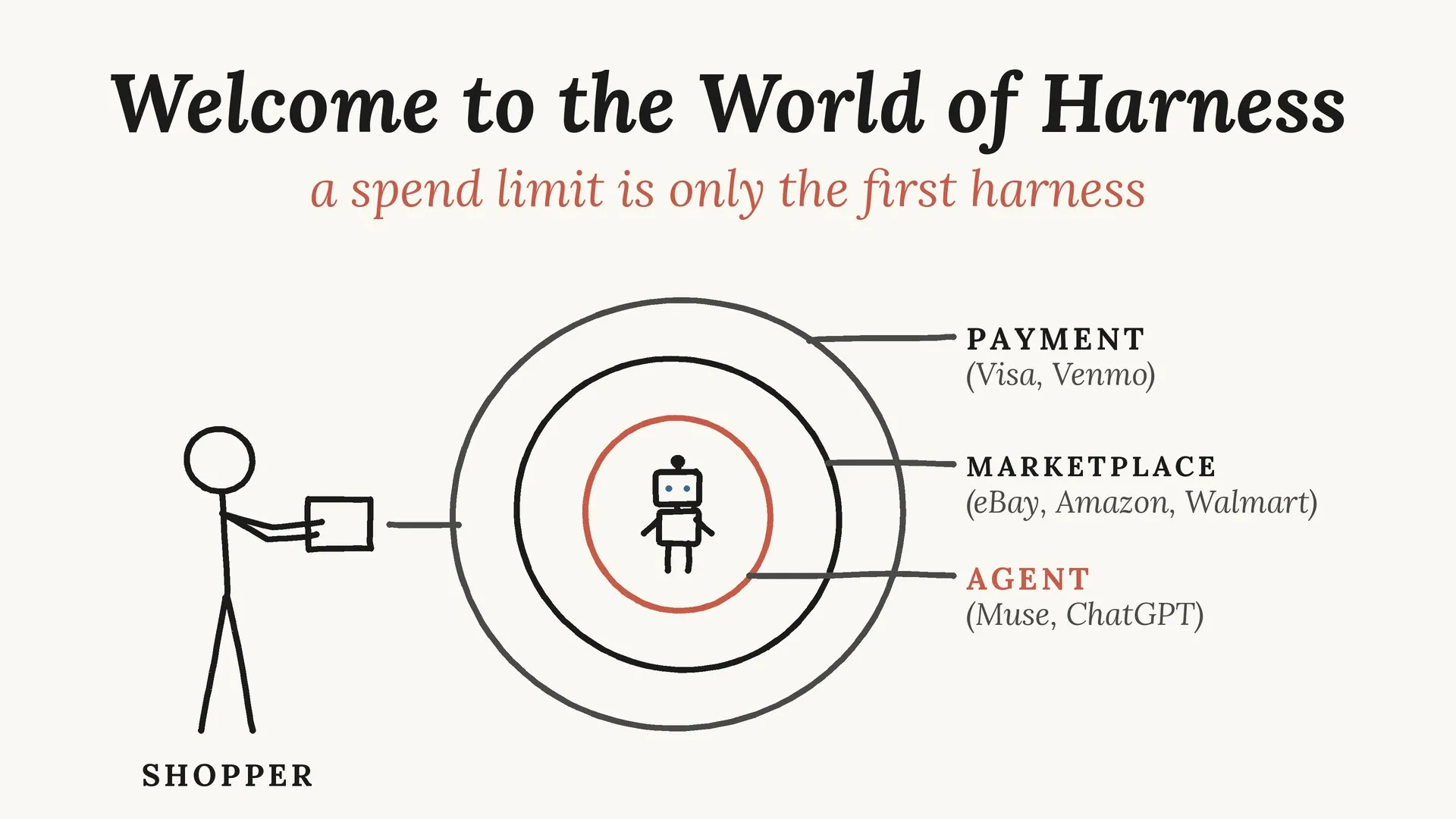
My view is that every layer in the purchase needs part of it, and each layer does a different job.
→ Payment layer: the loosest. Card networks and wallets have done a version of this for decades through fraud detection. It’s good at answering whether the purchase is really you. It doesn’t know whether you wanted the item.
→ Marketplace layer: the middle. The marketplace selling the item knows things the agent doesn’t: condition, seller history, return terms, and whether the listing matches the request. This is the layer I work on, and much of the trust in an agent purchase gets built here.
→ Agent layer: the tightest. Only the agent sees everything you’ve asked it across conversations. It’s the one that can say “you bought this yesterday, do you want another?”
No single layer can cover the others. A fraud model won’t catch a duplicate order, and an agent won’t know a seller has a history of late shipments. Shoppers need all three.
Why this matters for adoption
Early users put up with a thin harness because they’re curious. Most shoppers won’t let an agent spend their money until they trust the limits, and they also won’t sit through a long setup screen to define them.
So the harness has to learn most of its rules from behavior, remember them across conversations, and be enforced at more than one layer.
Opinion of my own. Does not reflect eBay’s position.
What’s a rule you’d want your shopping agent to follow that you’ve never said out loud?