On October 6, Meta and Sierra previewed Personal Agent Protocol, an open standard for how a personal AI agent like Meta’s Muse works with a company on your behalf. Sierra’s launch post named eight companies. A week later, the protocol’s site lists 43 design partners and a draft spec.
I’ve already compared the checkout protocols in Muse, UCP and ACP check out three different ways. I expected this to be a fourth way to check out. The partner list says otherwise.
Opinion of my own. Does not reflect eBay’s position.
Who signed up for Personal Agent Protocol?
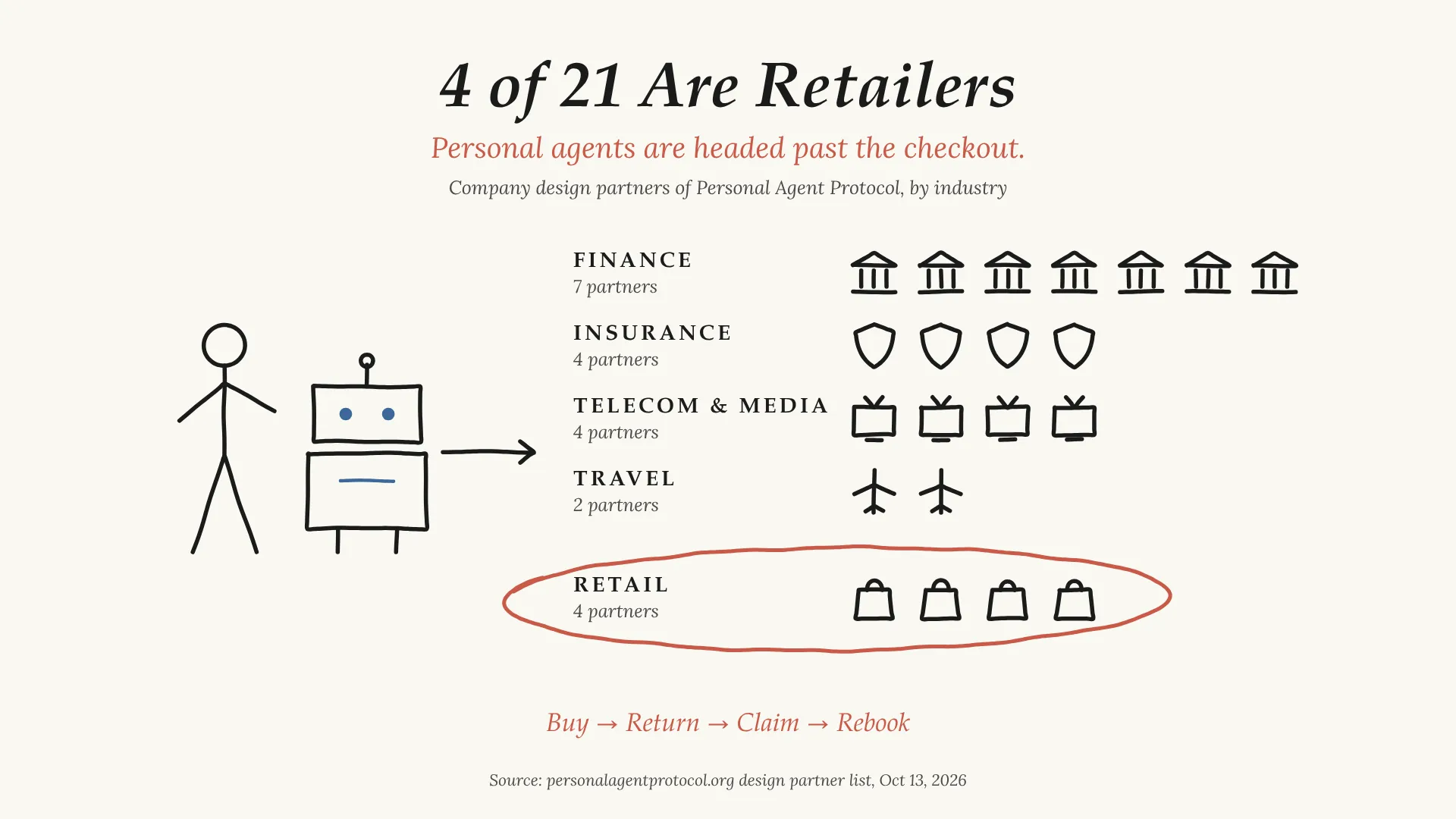
Of the 43 partners, 21 are companies that would offer the protocol to their own customers. Four are retailers: Gap, Nordstrom, Target and Walmart. The other 17 are banks and other finance companies, insurers, cable and media companies, an airline and a car rental company. (Reference https://personalagentprotocol.org/docs/path-to-1#partners as of Oct 15, 2026)
Only 4 of 21 company design partners are retailers
Source: Personal Agent Protocol design partner list, personalagentprotocol.org, as of Oct 13, 2026. Personal agent partners (Instinct, Meta, OpenAI) not shown. Industry groupings are mine; Rocket (mortgages and Redfin) is counted under finance.
The technology providers point the same way. Four of the 19 build customer service software: Genesys, NiCE, Zendesk and Sierra itself. Six handle payments or financial data. Three handle identity and security. Two are commerce and marketing tools, Shopify and Klaviyo.
Compare that with the checkout protocols. OpenAI and Stripe built ACP. Google co-developed UCP with Shopify, Etsy, Wayfair, Target and Walmart. Those lineups came together around a purchase. This one came together around an account.
What is Personal Agent Protocol?
In short, from the draft spec:
- Discovery. A company publishes a file at
/.well-known/poppy.jsonthat tells agents how to reach it. “Poppy” is the protocol’s nickname. - Sign-in. You sign in on the company’s own page through OAuth and choose whether your agent can view your account, make changes, or both.
- One session. The same session follows the agent across the company’s APIs, website and support agent, so the company sees one customer visit instead of three disconnected ones.
- Three ways in. The company picks what to offer: web pages, APIs (OpenAPI or MCP), or a conversation with its own agent.
Payments is on the list of open topics, outside the draft. With Stripe, Visa, Mastercard and Adyen involved, it will come. In UCP and ACP, checkout is the core. Here it will be an extension.
The worked examples on the site make the point. A jacket that keeps the rain out but isn’t warm enough. Internet that keeps dropping. A flight delayed overnight. None of them is a purchase.
Customer service is a Hard-to-Keyword problem
I’ve been writing about Hard-to-Keyword demand: things people want to buy but can’t compress into a search box. Customer service has the same shape, and it has had it for longer.
“My jacket keeps the rain out but isn’t warm enough” doesn’t fit in a search box. It doesn’t fit in a phone tree either. Press 1 for orders. Press 2 for returns. An IVR menu is a keyword box for service, and “press 0 for an agent” is how people have escaped it for decades. Help centers do the same thing in text, with a search box over articles written in the company’s vocabulary.
The measurement problem carries over too. Typed queries are survivors, and so are support tickets. A support team sees the issues that made it through the menu. The caller who hung up at “press 3” shows up as an abandoned call, with no record of what they needed.
A personal agent can explain the actual problem, in full sentences, to a company agent that can see the order history. If that works, the menu goes away, and so does the blind spot.
It also explains why contact center vendors signed up early. Sierra’s announcement says that when browsing fails, personal agents already fall back to calling the support line or opening web chat. Genesys and NiCE run those channels. They would rather set the terms for agent traffic than have it show up unannounced in their queues.
Why Meta needs a middle option
Amazon started blocking Muse in September. The protocol site describes the problem plainly. Today it’s all or nothing: a company either blocks the agent, or the agent signs in as you and can do anything you can. Companies try to detect agents, and agents try to avoid detection.
The protocol adds steps in between. The site uses a hotel as its example. Any agent can search rooms. After you sign in, your agent can see your reservations. With your approval, it can book. A company that would block an anonymous browser bot might accept an agent that signs in on its own page with limited permissions.
That’s the pitch to banks and insurers. They have the most to lose when an agent logs in as you with full access.
Who keeps showing up
Last month I noted that Shopify and Stripe show up in every checkout protocol. Both are here too. So are Target and Walmart, which co-developed UCP. And so is OpenAI, which co-created ACP and is listed here as a personal agent partner next to Meta and Instinct. Sierra’s launch post was written by its co-founders, Bret Taylor and Clay Bavor. Taylor is also OpenAI’s chairman.
Two things follow. The big players still aren’t picking camps. And the layers are separating. The checkout protocols cover the moment of purchase. This one covers the account around it. A shopper’s agent could check out through UCP or ACP and handle the return through Personal Agent Protocol. Whether a merchant wants to maintain three integrations to make that work is a fair question.
What’s still open
First, it’s a draft. The site says revisions before 1.0 can break compatibility. A design partner has agreed to be listed and to build against the draft. That tells you little about when customers will see it.
Second, a company agent is only as useful as what it’s allowed to do. If it can’t issue the refund or rebook the flight, your personal agent ends up waiting for a human, the same as you would.
Third, defaults decide a lot. Each company picks where it sits between blocked and full access. Banks and insurers will start cautious. If most companies settle on read-only, your agent can check a claim’s status and little else.
Fourth, look at who’s missing. Amazon, Google, Apple and Microsoft aren’t on the list. Amazon is blocking Muse, and Google has its own agent standards in A2A and UCP.
The checkout protocols already cover the moment someone buys. This is the first serious attempt to standardize everything that happens after, and the companies signing up are the ones with the longest phone trees.
If you run support: what’s the problem your customers can never get through your phone tree? I’d like to hear it.
Sources