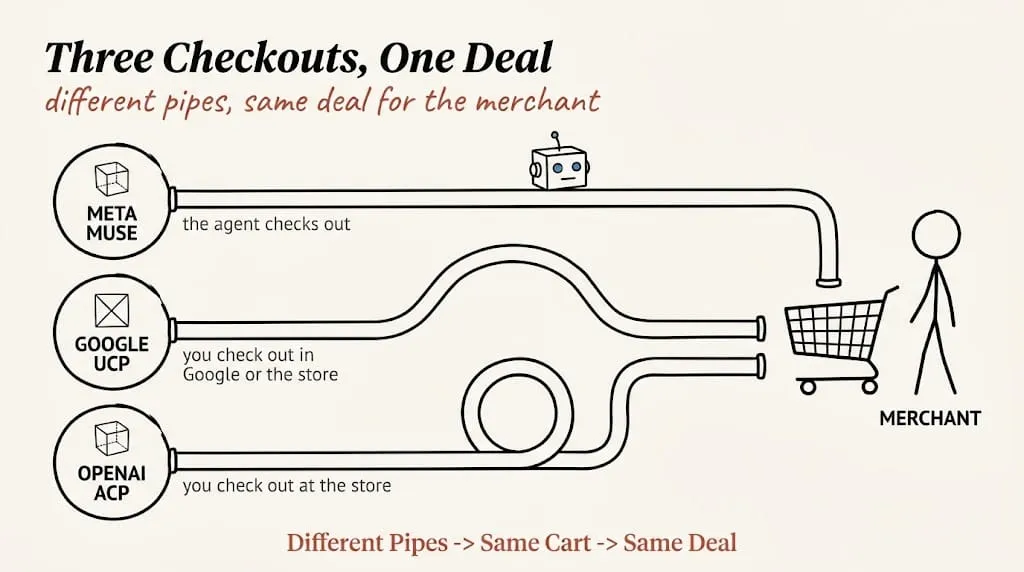
Meta’s Muse had a busy week. On Sunday night, September 20, Amazon started blocking it. On Monday, September 21, Shopify’s CEO announced that Muse will be able to check out through Shop Pay on Shopify stores. Add Google’s UCP and OpenAI’s ACP, and you have three of the biggest bets on how AI will buy things for you.
I work on agentic commerce at eBay, and I previously worked at Google Shopping, so I’ve been reading all of this closely. (BTW, views are of my own in this blog, not eBay’s.) My first instinct was to compare the three on checkout: who processes the payment, whose button you press, whose protocol wins. The more I dug in, the less that comparison mattered. They check out three different ways, but the merchant ends up with the same deal from all of them.
Here’s how each one works, laid out the same way so you can compare them.
Muse + Shopify (Meta)
Muse is Meta’s personal AI agent. It launched in the US on September 8, and it lives in its own app, on the web and inside WhatsApp. It runs on its own computer in the cloud, with its own web browser, and it’s built to suggest things before you ask. Meta’s example is turning a recipe reel you saved into a grocery list. When you buy something through Muse, the agent does the checkout. You approve the purchase and Muse handles the rest. At stores without a deal in place, it can go through the site’s checkout itself with its browser, paying through Link, Stripe’s wallet, which creates a one-time card for the purchase. At Shopify stores, once the new deal is live, it will search Shopify’s catalog and pay with Shop Pay.
For the merchant, the order looks like a regular sale. The store is still the merchant of record, ships the order and handles returns. What changes is consent. Through Shopify, the store’s platform has agreed to this on behalf of all its stores. Through the browser, nobody asked the store, and it may not even know an agent placed the order. That’s the core of Amazon’s complaint: it says shopping agents should identify themselves and respect a store’s decision about whether to take part. Where it stands today: Link checkout works now, and Shop Pay is still listed as coming soon, with no launch date.
UCP (Google)
UCP, the Universal Commerce Protocol, is an open standard Google launched in January, co-developed with Shopify, Etsy, Wayfair, Target and Walmart. It gives any AI agent a standard way to work with a store: search products, build a cart, check out, link a loyalty account and track the order. Google uses it in AI Mode and Gemini. Its Universal Cart, a single cart that works across stores, is headed to YouTube and Gmail. When you buy something through UCP, you check out either right inside Google with Google Pay or on the store’s own site. At some stores, Google’s agent can even complete the purchase for you, for example when a price you’re tracking drops, but only after you confirm.
For the merchant, the store stays the merchant of record, ships the order and handles returns. It can also connect the shopper’s loyalty account, so points still count. And the store, or the platform it runs on, chose to be there. Where it stands today: checkout is rolling out with big US retailers, with Canada and Australia next and the UK after that. Google has also said it will start bringing AP2, its protocol for letting agents pay within limits you set, to its products in the coming months.
ACP (OpenAI and Stripe)
ACP, the Agentic Commerce Protocol, is an open standard OpenAI and Stripe launched in September 2025. It gives an AI app a standard way to place an order with a store and pay with a Stripe token instead of your actual card number. It first powered Instant Checkout, a buy button inside ChatGPT. When you buy something through ChatGPT today, you usually finish on the store’s own site. OpenAI began phasing out Instant Checkout in March. Now ChatGPT recommends products and sends you to the store, or you buy inside a store’s own app within ChatGPT, like Walmart’s.
For the merchant, this is the most familiar deal of the three. The store is the merchant of record, and the shopper usually lands on its site, the same as a click from a Google search result. That wasn’t the original plan. Walmart found that purchases inside the chat converted at a third of the rate of shoppers it sent to its own site. Where it stands today: the standard is still around, and OpenAI is extending it to carry richer product data, but ChatGPT is now mostly a place to discover products.
Side by side
| Muse + Shopify | UCP | ACP | |
|---|---|---|---|
| Built by | Meta, with Shopify | Google and retailers | OpenAI and Stripe |
| Where you use it | Muse app, web, WhatsApp | AI Mode, Gemini | ChatGPT |
| Who does the checkout | The agent, after you approve | You, or Google's agent after you confirm | You, on the store's site or in its app |
| Merchant of record | The store | The store | The store |
| Did the store or its platform agree? | Via Shopify, yes. Via browser, no | Yes | Yes |
Different checkouts, same deal
Look at what the merchant gets in each case. In all three, the store is the merchant of record. It charges the payment, ships the product and handles the return. When the AI handles the payment, none of the three gives the store your real card number. Each uses a one-time card or a token. And big retailers aren’t picking one: Walmart and Etsy already work with both Google and OpenAI.
Two companies show up in all three: Shopify and Stripe. Shopify is a founding member of UCP’s Tech Council, lists its stores in ChatGPT, and is now Muse’s way into Shopify stores. Stripe co-created ACP, joined UCP’s Tech Council in April, and runs the Link wallet Muse pays with. Neither needs any one of them to win.
The lines between these camps are blurrier than the headlines. In April, Meta, Amazon, Microsoft and Stripe all joined UCP’s Tech Council, the group that steers the standard. For now, though, each still checks out its own way.
So for most merchants, choosing an AI checkout is turning into integration work. You’ll probably support all of them eventually, the way you accept both Visa and Mastercard.
The one difference merchants will feel is consent. With Muse’s browser, the store never agreed to anything. Amazon sits on UCP’s Tech Council right next to Meta. What it objects to is agents that show up without asking. I expect that to be the fight over the next year.
What’s actually different: where demand starts
Where the demand comes from.
When I was at Google Shopping, almost everything we measured about demand started with a query. If someone couldn’t type what they wanted into a search box, it never showed up in our data. I call that Hard-to-Keyword demand: things people want to buy but can’t easily search for.
Look at where each of these starts. Google’s shopping business grew up on what people type into a search box, and AI Mode and Gemini now let you describe what you want in full sentences. ChatGPT starts from that same kind of conversation. Muse is the one reaching past that. Meta says it can make suggestions unprompted and act on details you only mentioned once, like turning a recipe reel you saved on Instagram into a grocery list.
Google’s agent can already buy something for you after you confirm, but you picked the product first. Muse is the only one of the three that says it’s built to start from something you never asked for, and it can also check out for you. You just approve it. That makes it the boldest bet of the three, and the least proven.
Everyone is heading in the same direction, though. Google is taking Universal Cart to YouTube and Gmail, where a lot of shopping starts from a video or an email rather than a search. And checkout hasn’t been where people want AI’s help. In a March survey of people in the US, UK and Canada who regularly use AI answer engines, Forrester found that buying inside the answer engine was the least common use. Asking general questions and researching products were the top two.
What’s still open question?
First, this might not be new demand. If Muse notices you need a rain jacket before you do, you were probably going to buy one anyway, through a search, a friend’s recommendation or a store you walked past. An agent that finds demand earlier might just be taking it from another channel. In the data, those two look the same.
Second, it’s early. Muse’s Shopify checkout isn’t live yet. UCP is still rolling out. Most people still use these tools to research rather than to buy, and I’d expect the announcements to keep running ahead of actual shopping behavior for a while.
Third, Meta’s examples so far are grocery lists and dinner plans, not purchases nobody asked for.
So I’ve stopped asking which checkout wins. The more useful question is how much of what people buy they could never have searched for. That’s what my shopper survey is built to measure.