Hard-to-Keyword demand just showed up in an SEC filing.
On October 28, Alphabet released its third-quarter results and filed them with the SEC. Most of the attention went to Cloud. The line I care about is in the Search section: Google’s year-over-year query growth rate was the highest it has been in five years. Sundar Pichai tied that growth to Google’s AI investments, including on commercial queries.
The filing gives no query count and no growth percentage. The earnings call described what kind of queries these are. AI Mode queries are on average three times longer than traditional searches, and one in five AI Mode searches uses voice, images or documents. Philipp Schindler, Google’s chief business officer, said many of them are upper-funnel and that the majority of AI Mode queries are “incremental.”
That is a close description of what I call Hard-to-Keyword demand: real purchase intent that never became a search query because the shopper couldn’t fit it into the few words a search box would match. Until now, most of the evidence for it was anecdotal. Google’s numbers are the first large-scale signal I’ve seen.
Is query growth the same as Search revenue growth?
No. Most of the coverage I read blended the two, and they measure different things.
When I worked on Google Shopping, we tracked DAU and RPM as separate metrics. DAU, daily active users, tells you whether people keep coming back. RPM, revenue per thousand searches, tells you how much each search earns. The two don’t always move together, and everyone on the team knew the work that moves one is different from the work that moves the other. A launch can grow usage while revenue per search stays flat or drops.
Query growth is a usage number, in the same family as DAU. Search revenue depends on usage and on how much each search earns, which is where RPM comes in. Google reported Search & other revenue of $63.35 billion, up 12%, but gave no query growth number. Nobody outside Google can work out revenue per search from the filing.
J.P. Morgan’s Doug Anmuth asked about exactly this gap on the call. Schindler listed the causes in order. Currency was the single largest driver of the slowdown from Q2. Then two industry effects: some APAC retail advertisers were hit when the EU ended its de minimis exemption, and media spending came down after a World Cup-heavy Q2. Then he said the strong growth in AI Mode queries had an impact because AI Mode monetizes at a lower rate.
He didn’t say how much lower, or lower than what. Having worked at Google, I’m not going to fill that in with a guess.
What I can say is that the pattern looks familiar. Pichai described the plan himself: as with the shift to mobile, Google is focused on “building the best Search user experience, followed by monetization.” In my old team’s terms, that’s DAU first and RPM later. The RPM work has started. Schindler said click-through rates on sponsored and organic product listings in AI Mode are already similar, and Google is scaling ads in AI Mode to more queries, more countries, and multi-turn conversations in the US. In October I wrote that nobody was charging for the Hard-to-Keyword conversation yet. Scaling ads in AI Mode is Google starting to charge for it.
Incremental to what?
Google didn’t define “incremental” on the call. I’ll take the generous reading: most AI Mode queries would not otherwise have been typed into Google Search.
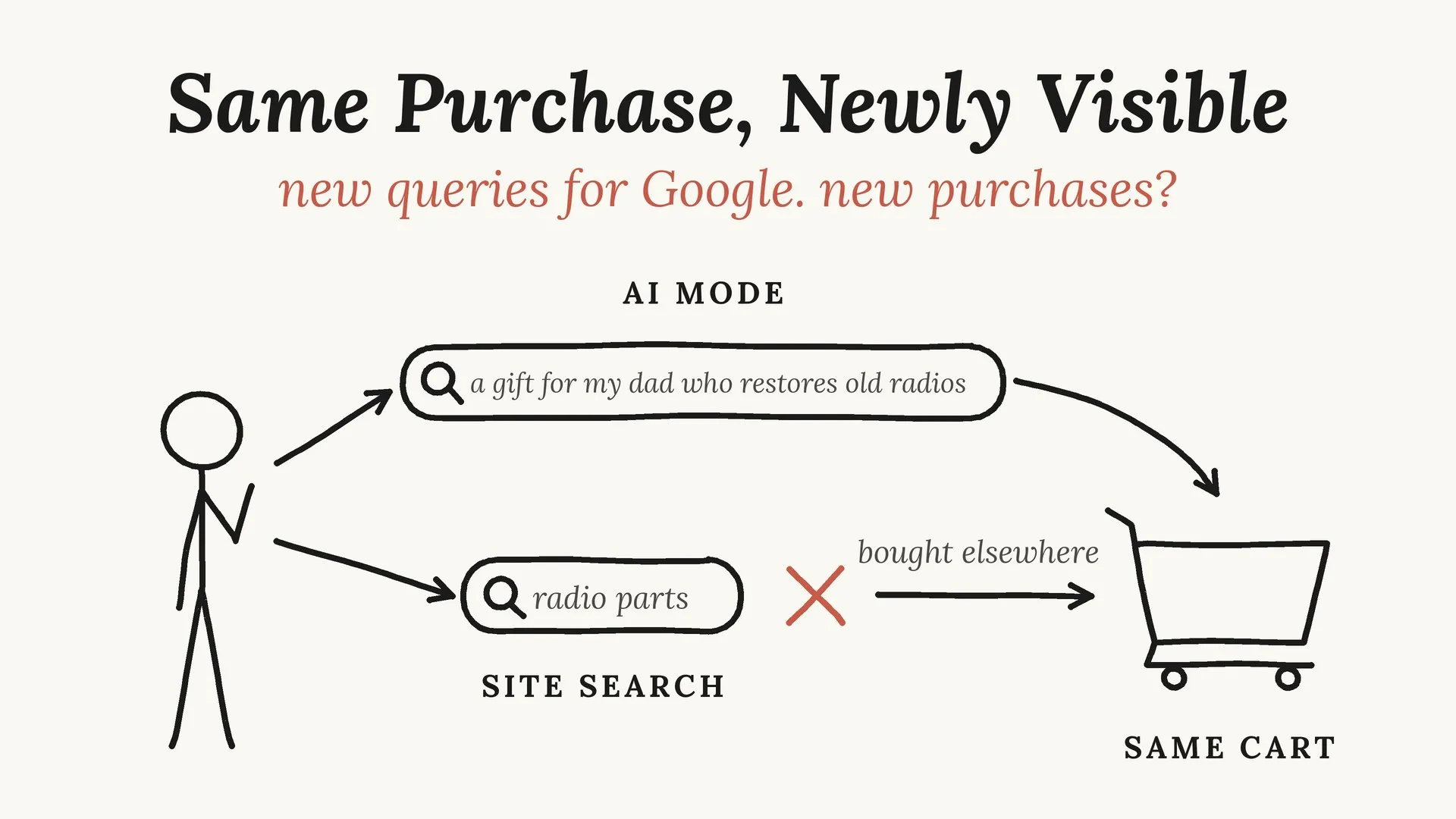
That can be completely true and still tell us nothing about whether people are buying more. A query that is new to Google can come from a purchase that was going to happen anyway, through some other channel.
Where were these shoppers before?
Here is the strongest objection to my argument. A Harris Poll survey commissioned by Google Cloud estimated that failed searches on retail sites cost retailers more than $2 trillion a year worldwide. If that money simply disappeared, then anything that recovers it creates new demand, and Google gained a market.
The same report mostly answers the objection. In the US survey, 3 in 4 shoppers said a failed search cost the retailer the sale. But 51% then bought the item somewhere else, and 25% didn’t buy it. Most of the $2 trillion moved from one retailer to another.
Shoppers paid for it in time and effort. The same survey found the time people spent shopping for a specific item on a retail site went from 15 to 25 minutes compared with summer 2021. A 2025 Coveo survey of 4,000 US and UK shoppers found 72% leave a site when they can’t find something quickly, and 53% go to Google next. Back in 2014, Baymard found that 70% of the 50 top-grossing US e-commerce sites required shoppers to use the site’s own word for a product type, so “blow dryer” failed on a site that called it a “hair dryer.” Baymard’s 2026 benchmark still rates 56% of sites mediocre or worse at search.
This is what I meant when I wrote that the search box punished people for typing more. Shoppers were asked to do the work: shorten the request, guess the site’s vocabulary, retry, try another site, ask Google. AI Mode takes on more of that work. When it does, a purchase that used to be spread across a retailer’s search box, a second retailer and a short Google query can show up as one long query in Google’s logs. Google gets a better view of demand that already existed. I’d describe that as Google gaining a new sensor. Whether it also gained a new market is the part nobody has shown yet.
The 25% who gave up are the open question. If AI Mode gets some of them to buy, that’s real market expansion. Nobody has published that number, Google included. It’s the split I want to measure.
Two caveats on these numbers. The Harris survey was fielded during the 2022 holiday season and commissioned by Google Cloud, which sells retail search. Coveo sells search too. I trust the direction of the data more than the size of the dollar figure.
What should PMs do differently?
Increase the aperture on what your search accepts. Shoppers now judge a search box against a conversation with an LLM. They will type the way they talk, and in AI Mode one in five searches isn’t typed at all. Baymard’s 2026 benchmark found 43% of sites struggle with use-case queries like “spring jacket” and 37% with symptom queries like “stained rug.” Those used to be edge cases. With LLMs setting expectations, they’re ordinary input.
Places to start:
- Test your search with the sentence a customer would say out loud, not the two words your team would type.
- Stop counting long or vague queries as low intent in your reporting. That label came from a system that couldn’t handle them.
- If you launch conversational search, track engagement and revenue per search as separate metrics, and decide upfront which one it is supposed to move. Google’s own AI Mode moved usage before revenue. Yours probably will too.
If you’ve launched conversational search on your own site, which number moved first?
Opinion of my own. Does not reflect eBay’s position.